


Victory for Viktoria: PACE Discusses Protecting Journalists During Wartime
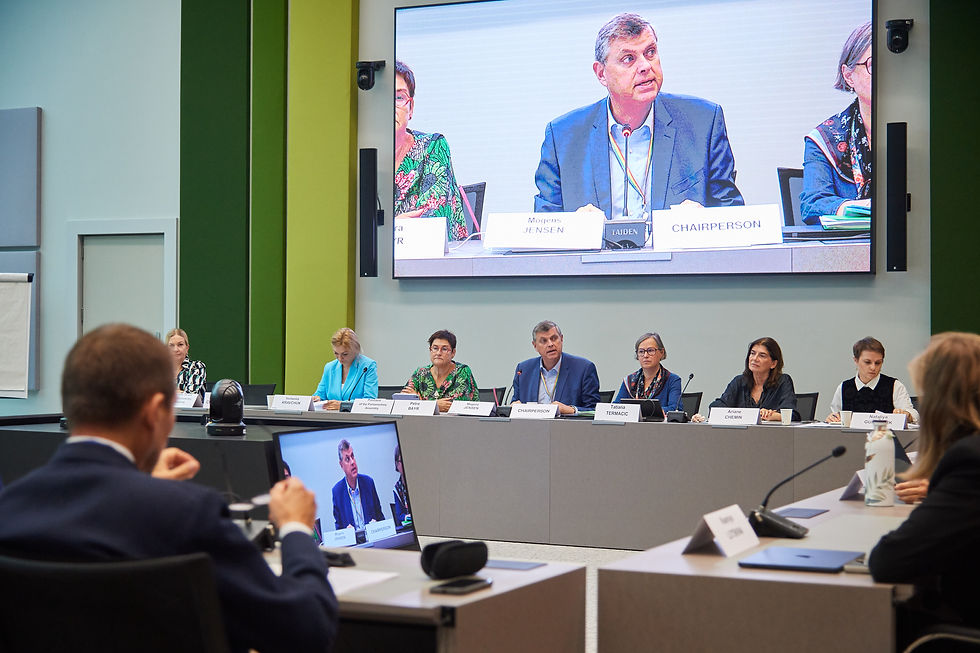
The Victory for Viktoria hearing took place in Strasbourg, honouring the memory of Ukrainian journalist Viktoria Roshchyna and addressing the protection of journalists working during wartime. The discussion was organised by the Committee on Culture, Science, Education and Media of the Parliamentary Assembly of the Council of Europe (PACE) during the Assembly’s autumn plenary session.
PACE established Victory for Viktoria Day in 2025 in honour of Viktoria Roshchyna, who was abducted by Russian forces while reporting from the occupied territories of Ukraine and died in Russian captivity. The annual commemoration is dedicated to war correspondents and journalists who risk their lives to report from conflict zones. This year marked its second edition.
The hearing’s speakers were Ariane Chemin, a reporter and author with the French newspaper Le Monde, and Nataliya Gumenyuk, a Ukrainian journalist, author and documentary filmmaker, and co-founder and executive director of the Public Interest Journalism Lab. PACE President Petra Bayr and Ukrainian MP Yevheniia Kravchuk, who prepared a report for the Assembly on Ukrainian journalists in Russian captivity, also took part in the discussion.
Participants discussed the persecution of journalists in Belarus, Russian propaganda and the role of verified information. Nataliya highlighted how attacks on Ukrainian infrastructure are accompanied by information campaigns designed to undermine trust and divide society.
The full hearing is available on YouTube. Below is the full text of Nataliya Gumenyuk’s speech, translated from the Ukrainian version:
Ariane’s words hurt deeply. Let me explain why. She mentioned another friend of mine, the Ukrainian artist Davyd Chychkan, an anarchist who volunteered to fight and was killed in combat. Viktoria’s grave is literally next to Davyd’s. I knew them both well. And now their graves are side by side. Davyd’s widow tends Vika’s grave when it needs attention. That is how close and real these stories are.
I was Viktoria’s manager for about three years. I led the independent Ukrainian media outlet hromadske, where she worked for five years. I was no longer working there when the full-scale invasion began or when Viktoria was taken captive.
But I knew Viktoria well. She was absolutely fearless. And I must make one correction: even if she were turning 30 next Tuesday, there would still have been no party. Viktoria never went to parties or hosted them. She worked all the time. We could never persuade her to stop and take a break. That was who she was.
Something else struck me: just yesterday, I was editing another story, about the occupation of the Zaporizhzhia Nuclear Power Plant in Enerhodar. That is where Viktoria went, and where she was abducted. Yet her earlier photographs from Enerhodar and the testimonies she collected before her death remain among the few materials available from there. We were trying to establish who had taken these important photographs. It turned out to be Viktoria. That, too, shows how much we have lost.
I will not repeat the details of the conditions in which she was held, but I want to emphasise this. Many other journalists have been killed. Many others remain in captivity. Viktoria was probably one of the best known.
For a long time, we, her colleagues, did not know exactly where she was. Later, we learned from people who had shared a cell with her and witnessed her being tortured, including with electric shocks, that she kept insisting she was a journalist. She was bold enough to demand that they at least bring charges against her. Throughout her imprisonment, they never did. The Russians did not even try to accuse her of anything.
We learned that by December, just four months after she was taken captive, her health had deteriorated catastrophically. Vika died the following September. There was no reason why Russia could not have released her that winter, when she was already gravely ill.
Today, we are talking about commemoration. I deeply appreciate this event, and I know Viktoria’s family would appreciate it too. But I must explain how painful it is for me to attend an event like this, an event dedicated to someone you knew personally.
I would also like to add that the Temporary Investigative Commission established by the Ukrainian parliament, together with Ukrainian investigators, has identified the people behind Viktoria’s death. One is Aleksandr Shtoda, the head of Pre-Trial Detention Centre No. 2 in Taganrog, who is already on the EU sanctions list. The other is Vyacheslav Perevozkin, the head of Pre-Trial Detention Centre No. 3 in Kizel, where Viktoria was killed. Ukrainian law enforcement authorities are investigating his actions. But his name must also be known, and he must face greater international scrutiny.
While Viktoria was in captivity, I had opportunities to speak at many forums. I spoke about her at a UNESCO event marking World Press Freedom Day. I spoke to the leadership of most of the organisations that support the media, including Reporters Without Borders and the Committee to Protect Journalists. We all knew she was there. We kept thinking: she is too well known; perhaps we should wait a little longer, perhaps later…
And we waited too long, until it was too late to secure her release.
That is why, every time I speak now, I remind people that 30 journalists remain in Russian captivity. Those are the ones we know about. What can we do now, instead of waiting until one of them is killed tomorrow or the day after? What can we do so that next year we do not have to commemorate them too?
That is my main appeal. If we have an opportunity to say their names, as Yevheniia does, we have a duty to do so.
I also want to speak about the journalists who continue to work. I was asked to say a little about our work. We do the same work as Ariane Chemin. There are so many extraordinary journalists working in Ukraine.
I am always glad when our work is recognised, when we receive awards. What I value most is that we are recognised for the work itself, rather than out of sympathy for the difficult circumstances we face.
For example, in one of our projects, I lead a team that collects testimonies about war crimes. We have gathered more than 600 detailed testimonies, recorded in a neutral tone. Half of them come from the occupied territories.
One of our team members, Oleh Baturyn, a local journalist from Kakhovka, was himself taken captive at the start of the war. Fortunately, he was released after eight days. He was treated with extreme brutality. But I want to emphasise this: after his release, once he managed to leave, he collected more than 50–60 crucial testimonies. He was the only person who could have done this, because he is a local reporter whose work focuses on the occupied Kherson region.
He is now writing about Oleshky, a Ukrainian town in the occupied part of the Kherson region that is under a Russian blockade. People there are on the brink of starvation, and Ukraine is calling for their evacuation to be allowed. Oleh’s reporting, based on conversations with people who trust him, is among the few accounts that allow us to understand what is happening there.
Behind journalists’ names are the stories we know because of them. It is thanks to these people that we receive verified information about the war, with its details and nuances.
I would like to draw your attention to one more thing. The situation is also deteriorating beyond the occupied territories, including in Ukraine’s rear and frontline areas.
Through another initiative, funded by international donors, mainly European ones, we support small newsrooms. Sometimes the amounts are very modest: two or three thousand euros. Over the past few years, we have supported hundreds of these outlets. Recently, we asked them to describe the conditions in which they work.
Their responses were very painful to read. Several dozen small outlets described their reporting trips and how they travel to villages where drones hunt them as they deliver newspapers. Sometimes they are the only ones reporting on a particular place, a small town in the Sumy, Chernihiv or Odesa regions. Often, they are the only ones reporting on the destruction in that community.
Sometimes you really do have to go there and deliver a printed newspaper, because there is no electricity. For older people, it is their only source of information. That is the reality.
The list of problems is so long that I do not have time to name them all or discuss each in detail. Broadly, they include the dangers of reporting on the ground, physical and psychological exhaustion from night-time attacks and chronic sleep deprivation. In some cities and towns, air-raid alerts last 24 hours. They include energy resilience and digital security, as many journalists, particularly those in the Donetsk and Zaporizhzhia regions, face constant cyberattacks. They include extensive destruction of property and the consequences for newsroom staff.
We cannot bring Viktoria back. Securing people’s release from captivity is extremely difficult, but we must keep talking about it. And we can help the journalists who continue to work: we can provide at least basic protective equipment and make their work possible. Because they will keep doing their work regardless.
In closing, I want to say this. In different countries, authoritarian regimes are trying to kill journalism. In this context, I can speak about Russia. There is no journalism in Russia. There is no journalism in Belarus. In many countries, it no longer exists.
In Ukraine, journalism exists. Journalists are being killed, but journalism is alive. It exists.
Working with many small and national media outlets, I have come to realise something else. There are thousands of them. Many have emerged over the past 15–20 years. They have held on. The full-scale invasion of 2022 did not destroy them. They are struggling. Sometimes a newsroom is just one or two people. Sometimes their budgets are absurdly small. When it comes to hyperlocal media, the quality is not always perfect. But they exist.
Having supported them and spoken with them over the past four years, I understand that this is an ecosystem, an environment we have built because Ukraine has democracy and a degree of pluralism. That is why we know what is happening. We should not take it for granted. We need to protect it, value it and continue to support it. And, in a way, this is a reason to celebrate these outlets. I still firmly believe that we can know what is happening because so many people are doing this work, in different ways and with different resources.
Sadly, Viktoria can no longer continue this work. But we must carry on for her.
Thank you very much.


Comments